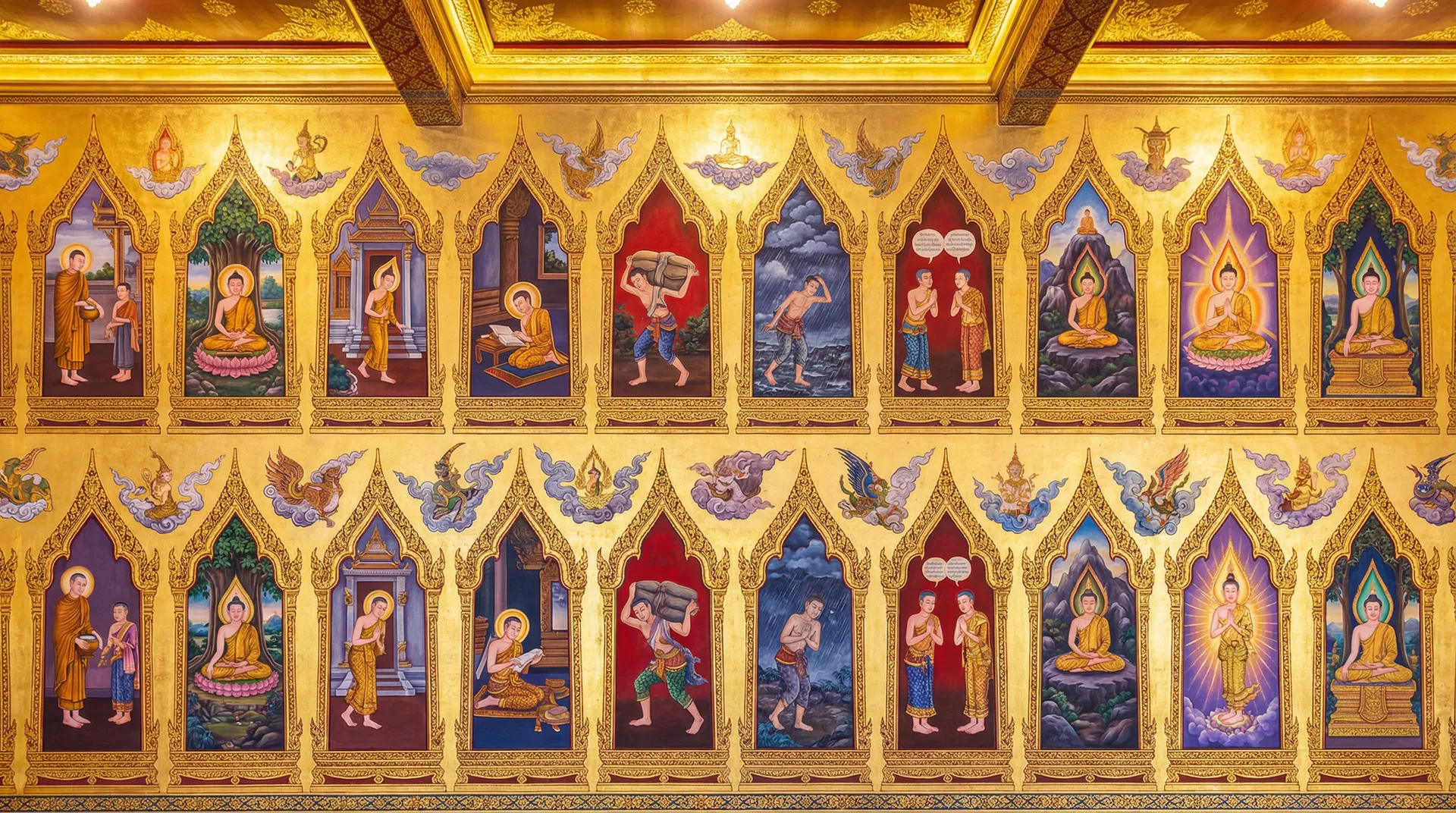
Mugapakkha Jataka
The Tale of the Mute Prince
In the ancient kingdom of Mithila, nestled amidst rolling hills and verdant plains, lived a wise and benevolent king named Vidhuratha. His reign was marked by justice and prosperity, but a shadow loomed over his heart. His queen, the radiant princess Ananga, had given birth to a son, Prince Mugapakkha, a child of unparalleled beauty and grace. Yet, from the moment of his birth, Mugapakkha remained silent, his lips sealed, his eyes observing the world with a profound, unutterable wisdom.
The court physicians and wise men were perplexed. They tried every remedy, every incantation, every plea, but the prince's silence persisted. Fear began to creep into the king's heart. What if his son, his heir, was forever bound to this voiceless existence? Would he be able to rule? Would he ever know the joy of speech, the sharing of thoughts, the laughter that echoes through the halls?
As Mugapakkha grew, his silence became a source of great concern. While other princes engaged in boisterous games and learned the art of rhetoric, Mugapakkha spent his days in quiet contemplation. He would wander through the royal gardens, his gaze fixed on the unfolding petals of flowers, the flight of birds, the gentle ripple of the water in the lotus pond. He seemed to communicate with the world through a language of his own, a silent understanding that transcended words.
One day, a renowned sage, known for his deep spiritual insight, visited the kingdom. King Vidhuratha, desperate for a solution, sought his counsel. The sage, after observing the young prince for a while, smiled. "Your Majesty," he said, "your son is not afflicted. He is enlightened. He has attained a state of profound inner peace, a realization that the true essence of existence lies beyond the fleeting nature of words. He speaks not because he has nothing to say, but because he has realized the limitations of language to convey the deepest truths."
The king was initially bewildered. "But how can he rule? How can he lead his people if he cannot speak?" he asked.
The sage replied, "True leadership does not always come from a loud voice, but from a silent, unwavering resolve, from a deep understanding of the hearts of men. Prince Mugapakkha's silence is his strength. He sees the world with clarity, unclouded by the noise of ego and desire. His actions, when he chooses to act, will speak louder than any words. He will lead not by command, but by example, by the sheer force of his wisdom and compassion."
Despite the sage's reassurance, the king remained apprehensive. He decided to test his son. He gathered his most trusted advisors and declared, "My son, Prince Mugapakkha, will soon ascend to the throne. But before he does, he must prove his worth. He must answer three riddles that will test his wisdom and his understanding of the world. If he answers them correctly, he will be a worthy king. If he fails, he will be banished from the kingdom."
The first riddle was posed by the chief minister: "What is the greatest treasure a man can possess?"
The court held its breath. Prince Mugapakkha, standing serene and unperturbed, looked at his father and then at the assembled courtiers. He then picked up a fallen leaf from the ground, its veins intricate and delicate. He held it up, and then let it drift to the ground. The silence stretched, and then, with a gentle gesture, he pointed to the leaf, then to his heart, and then to the sky. His meaning was clear: the greatest treasure is the boundless love and compassion that connects all beings, the understanding that we are all part of a greater whole.
The second riddle was posed by the general: "What is the greatest weapon a ruler can wield?"
Again, the prince remained silent for a moment. He then walked to a wilting flower in a nearby pot. He gently touched its drooping petals, and then, with a tender gaze, he looked at the king. He then mimed the act of watering, of nurturing. His silent answer resonated: the greatest weapon is not force, but kindness, the ability to nurture and uplift, to foster growth and understanding.
The third and final riddle came from the royal treasurer: "What is the greatest strength a kingdom can possess?"
Prince Mugapakkha looked out at the assembled people, their faces etched with anticipation. He then turned to his father, his eyes filled with a profound understanding. He placed his hand on his father's shoulder, then made a gesture of unity, of togetherness, of people standing shoulder to shoulder. His silent reply was evident: the greatest strength of a kingdom lies in the unity and harmony of its people, their shared purpose and collective will.
King Vidhuratha was overjoyed. His son, through his silent wisdom, had not only answered the riddles but had also revealed the true nature of kingship. He realized that true leadership was not about eloquent speeches or forceful decrees, but about inner wisdom, compassion, and the ability to inspire unity. He saw that Mugapakkha's silence was not a deficiency, but a profound testament to his enlightened state.
Prince Mugapakkha was crowned king. His reign was one of unparalleled peace and prosperity. He ruled with a quiet dignity, his actions guided by a deep sense of justice and empathy. The people, though they never heard his voice, understood him perfectly. They were guided by his silent example, his unwavering commitment to their well-being. The kingdom of Mithila flourished, a beacon of wisdom and compassion, all because of the silent king who spoke volumes through his enlightened presence.
— In-Article Ad —
💡Moral of the Story
True wisdom and leadership are not always expressed through words. Silence can be a powerful testament to inner understanding, compassion, and enlightenment. Actions and presence can speak louder than any speech.
Perfection: Wisdom (Prajna)
— Ad Space (728x90) —
More Jataka Tales You May Enjoy
 256Tikanipāta
Kaccābarāva Jātaka
Kaccābarāva JātakaIn the ancient land of Mithila, where rivers flowed like silver ribbons and forest...
💡 The greatest strength lies in selfless sacrifice for the well-being of others.
 161Dukanipāta
Mugapakkha Jataka
The Tale of the Mute PrinceIn the ancient kingdom of Uttarapatha, nestled between towering, snow-cap...
💡 True wisdom and leadership are not defined by the ability to speak, but by the capacity to understand, to act with compassion, and to serve the needs of others. Sometimes, the greatest voices are found in the deepest silence.
 100Ekanipāta
The Tale of Timpinnaka
In a time long past, when the Bodhisattva was yet a divine being, in this very existence he was rebo...
💡 True prosperity comes from a pure heart and selfless actions. Greed leads to destruction, while compassion and generosity create lasting blessings.
283TikanipātaSādhina Jātaka
Sādhina JātakaIn the sun-drenched kingdom of Kalinga, ruled a king named Sādhina, whose reign was ma...
💡 True wealth is not measured by material possessions, but by the well-being of one's people and the purity of one's heart. Greed leads to suffering and the decline of prosperity.
185DukanipātaKusa Jātaka
The Tale of the Excellent Kusa GrassIn the ancient kingdom of Kuru, on the banks of the sacred River...
💡 Acts of courage, compassion, and unwavering devotion, undertaken with pure intention, can overcome great obstacles and bring about renewal and hope, even in times of severe hardship.
159DukanipātaNimi Jataka
Nimi JatakaIn the ancient land of Videha, there ruled a king named Nimi. King Nimi was a paragon of ...
💡 Understanding the law of karma and the consequences of one's actions is essential for cultivating virtue and progressing towards liberation.
— Multiplex Ad —